Why NFTs Evolved Beyond Digital Art: The 2025 Utility Revolution Reshaping Ownership, Identity, and Finance


NFTs in 2025 give you new ways to control digital ownership, identity, and finance. Non-fungible tokens now link your physical and digital worlds. You use a token to prove ownership of a house, a luxury watch, or even a concert ticket. You gain access to web3 tools that let you manage your future with more security and transparency. Every token unlocks access to exclusive community spaces, digital assets, and new web3 experiences. NFT utility beyond art 2025 RWA tokenization NFTs Soulbound tokens now drive the future of digital ownership. People in every community use a token to share value, earn rewards, and prove access. You see web3 community growth in every sector. The global NFT market reached $49 billion in 2025, with 2.4 million users on OpenSea and 38% of all transactions coming from gaming NFTs. The average NFT sale price is $940, and daily, 410,000 people use NFT wallets. Ownership, access, and community define the future of digital ownership. You shape the web3 future by using a token to build value, join a community, and unlock new access.
Statistic | Value |
|---|---|
Global NFT market size | $49 billion |
Ethereum transaction share | 62% |
OpenSea monthly active users | 2.4 million |
Gaming NFTs transaction volume | 38% |
Average NFT sale price | $940 |
U.S. buyers share | 41% |
Projected market valuation | $61.01 billion |
CAGR from 2020 to 2025 | 41.90% |
Key Takeaways
NFTs now connect your physical and digital worlds, allowing you to prove ownership of real assets like homes and tickets.
Real-world asset tokenization through NFTs makes ownership simpler and more accessible, eliminating the need for middlemen.
Soulbound tokens (SBTs) enhance privacy and control over your identity by securely storing personal credentials in your wallet.
Fractional ownership of NFTs allows you to share high-value assets, making investments more accessible and collaborative.
NFTs are transforming finance by enabling new revenue models, such as using NFTs as collateral for loans and earning royalties.
NFT Utility Beyond Art 2025
NFTs in 2025 give you more than digital art. You use them to connect your physical world to your digital life. This section shows what nft utility beyond art 2025 rwa tokenization nfts soulbound means for you. You see how digital ownership, digital assets, and utility shape your daily experience. You discover what real-world projects use NFTs for value, ownership, and access.
RWA Tokenization NFTs
You now see NFTs as tools for real-world asset (RWA) tokenization. You use NFTs to buy, sell, and trade digital assets that represent physical things. You can own a piece of a building, a luxury car, or even a share in a hotel. This makes digital ownership simple and safe. You do not need to trust a middleman. You trust the blockchain.
You can invest in the St. Regis Aspen Resort by buying Aspen Coin, a digital token. This lets you own a share of a luxury hotel. You get more liquidity and access to high-value real estate.
You find that tokenized assets make luxury goods and real estate open to more people. You can join real-world projects that let you invest in things you could not before. You see new value in digital assets that link to physical items.
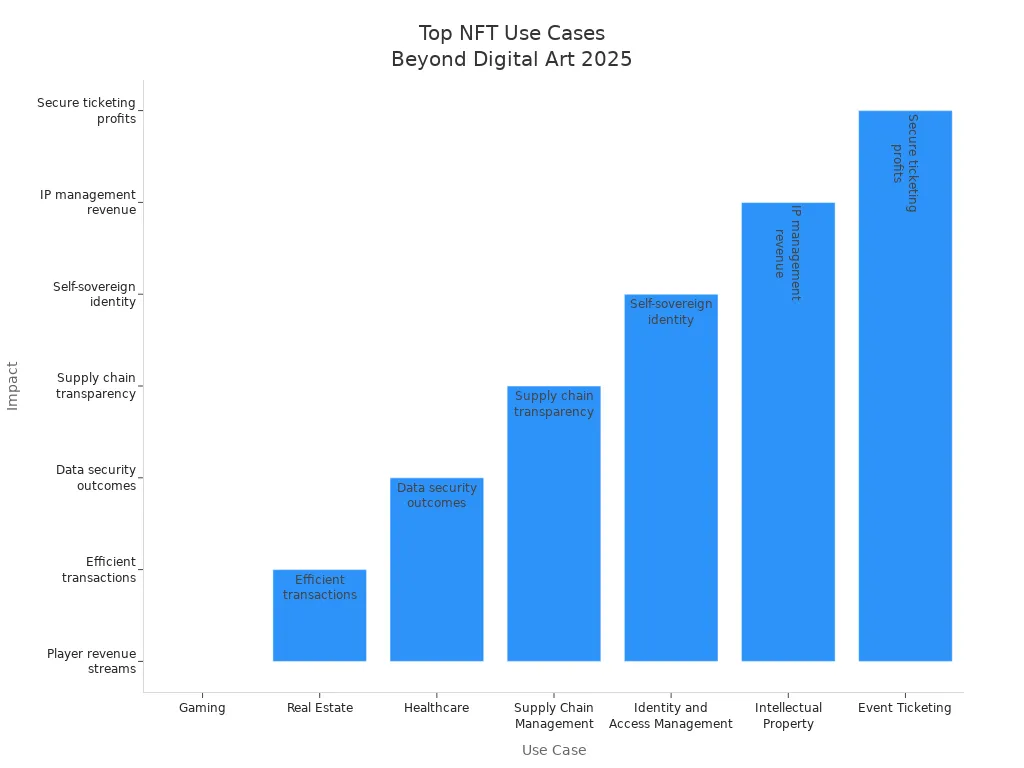
Here is a table showing what NFTs do outside of digital art in 2025:
Use Case | Problem Description | NFT Solution | Examples | Impact |
|---|---|---|---|---|
Gaming | Centralized control over in-game assets, limiting player ownership. | True ownership of in-game assets, enabling trading across platforms. | Axie Infinity, The Sandbox | New revenue streams for players and developers, enhancing engagement. |
Real Estate | Cumbersome transactions with high fees and potential fraud. | Streamlined buying/selling process with ownership represented by NFTs. | Propy, RealT | More efficient and transparent transactions, enabling fractional ownership. |
Healthcare | Fragmented data sharing and verification issues. | Medical records represented as NFTs for secure sharing and authenticity. | MedRec, VitaDAO | Improved data security and patient outcomes, new funding models for research. |
Supply Chain Management | Lack of transparency in tracking goods, leading to inefficiencies. | Products represented by NFTs for transparent provenance tracking. | IBM Food Trust, VeChain | Enhanced transparency, reduced fraud, and improved efficiency in supply chains. |
Identity and Access Management | Vulnerable centralized identity systems. | Digital identities represented by NFTs for self-sovereign control. | Civic, Sovrin | Empowered individuals with control over their data, enhancing privacy and security. |
Intellectual Property | Difficulty in protecting IP and ensuring fair compensation. | Ownership of IP represented by NFTs, enabling automatic royalty payments. | Mycelia, Ujo Music | Revolutionized IP management, providing new revenue streams for creators. |
Event Ticketing | Fraud and inefficiencies in traditional ticketing systems. | Event tickets represented as NFTs for authenticity and transparent resale. | GET Protocol, YellowHeart | More secure and fair ticketing, reducing fraud and ensuring artists receive resale profits. |
You see that digital assets now solve problems in many fields. You get more value, better security, and easier access to ownership.
Phygital Assets and Digital Ownership
You use NFTs to link physical products to digital assets. This is called phygital ownership. You get a digital twin for your sneakers, art, or fashion. You prove digital ownership with your NFT. You unlock special rewards, events, or discounts.
Diesel’s D: Verse collection gives you an NFT with your fashion item. You get access to exclusive events.
Nike’s RTFKT NFTs come with real sneakers. You own both the digital and physical versions.
Damien Hirst’s “The Currency” lets you choose between a physical painting or its NFT.
TEMPLA’s “Unworld Boots” have an NFC tag that links to a digital NFT.
Another-1 Phygital Jersey gives you a real jersey and a digital NFT.
NTR1-Meta Phygital Sneaker connects your Italian sneaker to its NFT.
Louis Vuitton’s VIA Treasure Trunk links each NFT to a real trunk and gives you access to future products.
You see that digital ownership now means more than just holding a file. You use NFTs to prove you own both digital assets and physical goods. You join real-world projects that give you new ways to show value and utility.
Here are some real-world projects using phygital NFTs:
Case Study | Description |
|---|---|
Mercedes | Tokenized vehicles based on NFTs. |
Hyundai | Tokenized driver data with NFTs for sharing and monetizing data. |
Tokenized batteries enabling rights-to-repair. | |
Adidas | Tokenized wearables like sneakers integrated into virtual worlds. |
You use digital assets to join communities, unlock new experiences, and prove digital ownership in both worlds.
Fractional Ownership
NFTs now let you share digital ownership with others. You can own a part of a ticket, a collectible, or a real estate property. This makes high-value digital assets easy to access. You do not need to buy the whole item. You buy a fraction and share the value.
Source | Description |
|---|---|
Fractional NFT Marketplace Development Services | Users can jointly obtain fractional NFTs to participate in virtual exclusive events, enabling shared ownership of tickets. |
TEX Ticket Market NFTs | This platform allows event organizers to mint and sell tickets as NFTs, providing control over the ticket lifecycle and enhancing security and flexibility in ticket sales. |
You join events with friends by sharing digital assets. You invest in collectibles with others. You use NFT ownership to unlock value and utility in new ways.
You see that nft utility beyond art 2025 rwa tokenization nfts soulbound is not just a trend. You use NFTs for digital ownership, digital assets, and utility every day. You join real-world projects that give you more value, more access, and more ways to prove ownership. You shape the future of digital assets with every NFT you own.
Decentralized Identity and Soulbound NFTs

NFTs now shape how you manage your digital identity in 2025. You use a nft to prove who you are, control your credentials, and access services securely. This new approach gives you more privacy and control than ever before.
Soulbound Tokens
Soulbound tokens (SBTs) are a special type of nft that you cannot transfer. You use them to store personal credentials, such as diplomas or medical records, directly in your wallet. SBTs help you keep your identity safe and private. In healthcare, you own your vaccination certificate as an SBT. You store your health records in your wallet and decide who can see them. SBTs make your data secure and easy to share when needed.
SBTs link to your private wallet and identity, so only you control your qualifications and medical history.
Here is how SBTs improve healthcare:
Aspect | Description |
|---|---|
Purpose | Solves authentication problems in healthcare using decentralized systems. |
SBT Characteristics | Non-transferable tokens that hold personal credentials on the blockchain. |
Benefits | Boosts data security, speeds up authentication, and improves interoperability. |
Patient Control | Lets you store and manage your health data and control access. |
NFT Identity Verification
You use nft technology to verify your identity for school, work, and online communities. Each nft credential is unique and traceable, so you know your records are real. Schools issue digital certificates as nfts, showing your achievements on the blockchain. Employers check your nft credentials to confirm your skills and education. This process stops fake degrees and makes hiring fair.
NFT digital identity helps you prove your academic history.
NFT credentials are easy to verify and cannot be changed or faked.
Digital certificates as nfts show your achievements and skills.
Digital Credentials
NFTs give you new ways to manage digital credentials in many sectors. In education, you receive nft certificates for your grades and awards. In employment, you use nft credentials to show your skills and experience. In DAO governance, you get an nft that proves your right to vote or participate. You build a digital resume with nfts that show your contributions and reputation.
NFTs in DAOs give equal rights to all members, not just those with more tokens.
You use nft badges to access special roles or permissions.
Smart contracts use nfts to automate voting and decision-making.
Here is a table showing the benefits and challenges of using nfts for decentralized identity:
Benefits | Challenges |
|---|---|
Self-sovereignty | Regulatory uncertainty |
Enhanced privacy | Focus on ownership over identity solutions |
Interoperability | |
Portability |
NFTs now let you control your identity, credentials, and access in ways that were not possible before. You use nfts every day to prove who you are and what you have achieved.
Gaming, Metaverse, and Digital Ownership
NFTs change what you can do in gaming and virtual worlds. You now have digital ownership of your in-game items, land, and characters. This means you control your assets, not the game company. You can trade, sell, or keep your items as you wish. Digital ownership gives you freedom and real-world value.
Play-to-Earn NFT
You use play-to-earn nft games to earn rewards while you play. These games let you collect, breed, and battle digital creatures or items. You own each nft you win or buy. You can sell these nfts for real money or trade them with other players. Popular platforms include:
Ethereum: The most established for nft games, but you may see high fees.
Polygon: Offers low costs and fast transactions for nft gaming.
Immutable X: Used for AAA games with instant, gas-free nft trading.
Solana: Supports fast, real-time nft gaming.
Ronin: Built for nft games, making your experience smooth.
Axie Infinity is a top play-to-earn nft game. You earn tokens by playing and can use or sell them. This model gives you digital ownership and lets you turn your time into value.
Interoperable Metaverse Assets
You use nfts to move your digital assets between different games and worlds. This is called interoperability. Your nft avatar, land, or item works in more than one place. You keep digital ownership no matter where you go. Here are some leading projects:
Project | Description |
|---|---|
Own land, avatars, and items as nfts, usable across platforms. | |
The Sandbox | Create and trade nfts, moving assets between games. |
Axie Infinity | Trade nft creatures across different platforms. |
Interoperable nfts give you more value and flexibility. You decide how to use your digital ownership.
Creator Revenue and Royalties
NFTs change how creators and developers earn money. You get paid every time your nft sells, even if someone else owns it. Smart contracts make sure you receive royalties automatically. This system gives you steady income and rewards your work. Here are some features:
Creators get automatic resale royalties.
Immutable records prove digital ownership and stop fake nfts.
Limited supply increases nft value and earnings.
Revenue Model | Impact on Earnings |
|---|---|
Transaction Model | Ongoing passive income from nft transaction fees. |
Continuous Earnings from Marketplaces | More engagement means more revenue from nft sales and events. |
NFTs give you digital ownership, real value, and new ways to earn in the gaming world.
NFTfi, DeFi, and Revenue Models
NFTs now play a core utility role in DeFi and finance. You see digital ownership changing how you use, lend, and earn from assets. NFTfi platforms let you unlock new revenue streams and create recurring revenue strategies. You use NFTs for more than art—they become tools for ownership, liquidity, and revenue innovation.
NFT Collateral and Lending
You can use your NFT as collateral for loans. This means you do not need to sell your digital ownership to get cash. You keep your ownership and still access liquidity. NFTfi platforms make this possible. You see both decentralized and centralized lending options. Retail and institutional investors join these platforms for yield and risk diversification.
Recent trends show that NFT collateralization is growing fast. The global NFT Collateralized Lending market reached $1.48 billion in 2024. Experts expect it to reach $11.98 billion by 2033. You see more people using NFTs as collateral because it brings flexibility and new revenue opportunities. You can borrow money, pay it back, and keep your digital ownership. This creates a new way to use NFTs for utility and revenue.
NFT owners now access liquidity by using their NFTs as collateral on DeFi platforms. You can join peer-to-peer lending pools. You can also use NFT-backed loans to leverage your assets. This diversity in collateralization methods gives you more control and more ways to earn revenue.
Fractionalized NFTs in Finance
Fractionalized NFTs let you own a part of a high-value asset. You do not need to buy the whole NFT. You buy a fraction and share the digital ownership with others. This makes expensive assets like real estate or rare collectibles easy to access. You see more liquidity in markets that were once hard to trade.
In 2025, fractionalized NFTs help you tokenize real-world assets.
You can trade your share of a building, car, or artwork on digital platforms.
NFT collateralization lets you lock up your share for loans, giving you liquidity without selling your ownership.
NFTs are now staked, rented, and used as collateral. This is the essence of NFTfi. You see ownership and liquidity working together. This reshapes how you use assets for revenue and utility.
Here is how fractionalized NFTs work:
You divide an asset into digital tokens. Each token represents a share of ownership.
These tokens are stored on a secure blockchain ledger. This keeps your ownership safe and authentic.
You trade these tokens on digital platforms. This creates a liquid market for assets that were once hard to sell.
Fractional ownership allows you to join token-gated clubs and access exclusive experiences. You see more buyers and more revenue sharing. NFT staking lets you lock your NFTs in smart contracts to earn rewards. This adds more token utilities and revenue innovation to your digital ownership.
Institutional Adoption
Institutions now see NFTs as more than collectibles. You notice that 21% of institutions explore NFTs for branding and engagement. They use NFTs for loyalty programs, exclusive content, and token-gated access. Brands like Starbucks and Nike use NFTs to connect with you and offer new digital ownership experiences.
Institutions use NFTs for revenue-sharing instruments and direct-to-consumer ownership. You see new revenue models, such as revenue sharing from NFT sales and recurring revenue from token utilities. These models help brands build stronger communities and offer more value.
NFTs now serve as financial tools for both individuals and institutions. You see more revenue innovation and more ways to use digital ownership for utility and finance. NFTfi platforms give you access to new revenue streams, token utilities, and ownership models that were not possible before.
NFTs have become a core utility in DeFi, giving you new ways to earn, borrow, and share revenue. You use digital ownership to unlock value, join token-gated clubs, and shape the future of finance.
NFTfi, DeFi, and revenue models now define what NFTs can do for you. You use NFTs for ownership, utility, and revenue in every part of your digital life.
Dynamic and AI-Generated NFTs
NFTs in 2025 have become more than static images or collectibles. You now see what happens when AI and dynamic features combine with digital ownership. This new wave of nft technology gives you more utility and creative power than ever before.
AI NFTs and Generative Art
AI-generated NFTs have changed what you expect from digital art. You can own a piece of art that an AI creates, making each nft unique. Artists use AI tools to explore new styles and techniques. This opens up new creative paths and changes how you value digital art. You see that AI-generated NFTs let you collect evolving masterpieces. These pieces can change over time, giving you a living form of ownership. The nft market now includes art that grows and adapts, making your collection more dynamic. This shift also means more people can create and own digital art, changing how you think about utility and value.
Dynamic Utility NFTs
Dynamic NFTs give you ownership that evolves. You can own an nft that changes based on real-world events or your actions. For example, you might own a sports nft that updates with a player’s stats. Some NFTs reward you for holding them or for joining community events. This table shows what dynamic NFTs can do:
Example | Description | Use Case |
|---|---|---|
LaMelo Ball x Chainlink | NFTs evolve with real-life game stats | Fan engagement, performance-based rarity |
Moonbirds | NFTs change with staking behavior | Community engagement, long-term rewards |
Pak’s “The Merge” | NFTs grow as users combine tokens | Fractional ownership, experimental media |
Async Art | Programmable NFTs with layers that owners can change | Collaborative, living digital artwork |
You see that dynamic NFTs bring new utility to digital ownership. They let you interact with your assets and unlock new experiences. This makes your nft collection more valuable and useful.
Sustainability and Carbon-Neutral Platforms
NFT platforms now focus on sustainability. You want your digital ownership to have a low carbon footprint. Many platforms use proof of stake to cut energy use. Ethereum’s move to proof of stake reduced its energy use by over 99.9%. Other blockchains like Cardano, Solana, and Tezos also use energy-saving methods. Some projects use carbon offsets, such as minting NFTs that represent real trees. Sidechains help by grouping transactions, which lowers energy costs. You now see that nft utility and ownership can be both innovative and eco-friendly.
Challenges and Future Outlook
Regulation and Compliance
You face new rules as digital ownership grows. What are the main regulatory challenges for NFT utility in 2025? Many countries now require strict checks for identity and finance. Smaller NFT platforms must follow Know Your Customer (KYC) and Anti-Money Laundering (AML) laws. These rules can raise costs and slow innovation. Different regions may apply these rules in different ways, which can cause confusion. The table below shows what you need to know about regulation:
Regulatory Challenge | Description |
|---|---|
Smaller NFT marketplaces face difficulties complying with MiCA’s KYC and AML obligations, increasing operational costs. | |
Potential stifling of innovation | MiCA’s broad interpretation of financial instruments may limit NFT experimentation, discouraging new business models. |
Concerns over enforcement | Different EU nations interpret MiCA differently, leading to inconsistencies in its application. |
Scalability and User Education
What are the main barriers to scaling digital ownership and utility? As more people use NFTs, you see slow transactions and high fees, especially on Ethereum. NFT platforms now use Layer 2 solutions like Polygon and other blockchains such as Solana to speed up transactions and lower costs. These changes help you enjoy smoother digital ownership and utility experiences.
User education is also key. What strategies help you learn about NFT utility, digital ownership, and finance? Schools and online courses now teach you how to use NFTs. Gamified lessons reward you with NFTs for learning new skills. The table below shows what education strategies work best:
Strategy | Description |
|---|---|
Incorporating NFTs into existing educational systems to enhance learning experiences. | |
Gamification | Using NFTs in educational games to reward students for completing tasks, boosting engagement. |
Digital Literacy | Teaching students to navigate and create within the digital landscape, essential for NFT use. |
Regular Evaluation | Continuously assessing NFT programs to adapt to technological changes and educational needs. |
Mainstream Adoption
What drives mainstream adoption of NFT utility, digital ownership, and finance? You now see NFTs used for event access, discounts, and memberships. The fashion industry uses NFTs to prove digital ownership and boost customer loyalty. Artists and brands use NFTs to connect with you and offer new experiences. The table below highlights what supports mainstream adoption:
Evidence Description | Key Insights |
|---|---|
Utility NFTs provide practical functionalities beyond mere ownership. | They offer access to exclusive events, discounts, and memberships, enhancing customer loyalty. |
The market is driven by rising digital transformation in the fashion industry. | The shift to digital platforms has increased the integration of NFTs for ownership and engagement. |
Interest from creators and collectors is propelling the market. | Digital artists and fashion designers are monetizing creations through NFTs, attracting collectors. |
What is next for NFT utility? Experts predict that NFTs will expand into entertainment, sports, and gaming. You will see more digital ownership of in-game items, sports collectibles, and music content. NFTs will shape how you manage identity, access, and finance in your daily life.
NFTs now shape what digital ownership means for you. You use them for identity, finance, and real-world asset ownership. The table below shows what NFTs bring to digital ownership, identity, and finance:
Source | Key Takeaway |
|---|---|
The evolution of non-fungible tokens (NFTs) | NFTs are now used for digital identity and customer engagement, providing exclusive access and verifiable proof of membership. |
Using NFTs to Represent Real-World Asset Ownership | NFTs democratize asset ownership, increasing transparency and efficiency in ownership interactions. |
Smart Contracts and NFTs in 2025 | Smart contracts enhance NFT transactions, enabling real-world asset tokenization and programmable royalties. |
You see digital ownership as more than a trend. You gain exclusive access, discounts, and voting rights. You use NFTs for identity verification, asset tokenization, and event tickets. Understanding NFT utility helps you unlock new opportunities and shape what digital ownership means in your world.
FAQ
What is an NFT utility?
NFT utility means the real-world use or function of an NFT. You can use NFTs for ownership, access, rewards, or proof of identity. Utility gives your NFT value beyond just being a digital collectible.
What are real-world examples of NFT use beyond art?
You see NFTs used for real estate ownership, event tickets, digital identity, and in-game items. Brands like Nike and Louis Vuitton use NFTs to link physical products to digital assets.
What makes a Soulbound Token different from a regular NFT?
A Soulbound Token (SBT) cannot be transferred or sold. You use SBTs to store personal credentials, like diplomas or medical records. Only you control your SBTs, making them secure for identity and achievements.
What is fractional NFT ownership?
Fractional NFT ownership lets you own part of a high-value asset. You buy a share of an NFT, like a piece of real estate or a rare collectible. This makes expensive assets more accessible to you.
What is NFTfi?
NFTfi stands for NFT finance. You use NFTs as collateral for loans, earn rewards by staking NFTs, or share revenue from NFT sales. NFTfi creates new ways for you to use and earn from your digital assets.
See Also
Exploring Web3: Join the Next Wave of Digital Innovation
August 2025: A Pivotal Time for Web3 and Regulation
Smart Contracts in 2025: Transforming Trust Through Automation
The Impact of AI Mergers on Web3 and Tech in 2025
Tech's Great Reckoning: Regulation, Quantum Power, and Trust Issues